In recent years, the use of PFAS (per- and polyfluoroalkyl substances) in food contact materials has become a focus of industry and public attention. These chemicals used for their excellent water and oil repellency, are now raising concerns about their potential health risks and environmental hazards.
How should we choose between "safety" and "function"?
Zhong Huaining, Director of the National Key Laboratory for Food Contact Materials Testing (Guangdong), provides the industry with forward-looking insights into the core logic and feasible paths for PFAS transformation in the food packaging industry.
-
PFAS in the Spotlight: Four Reasons Driving Industry Change
The increased attention given to PFAS in food contact materials stems from four key factors:
· A Surge in PFAS-Related Substances: The OECD (Organisation for Economic Co-operation and Development) updated its definition of PFAS in 2021 raising the number of regulated substances from over 4,000 to 10,000. In 2021, the OECD (Organisation for Economic Co-operation and Development) expanded the scope of PFAS defining them as substances that contain at least one perfluorinated methyl (–CF₃) or methylene carbon atom (–CF₂–), without any hydrogen, chlorine, bromine, or iodine atoms bonded to these carbon atoms. This accepted definition raised the number of substances covered by PFAS from over 4,000 to 10,000.

• Regulations are becoming increasingly stringent: The EU, France, Canada, and other countries have successively formulated regulations to shift the control of PFAS from individual substances to broad restrictions or bans, and generally adopt the total fluorine/total organic fluorine threshold (the content of all fluorine elements or fluorine elements existing in organic forms). The EU's PPWR regulation sets limits on both the total amount of PFAS and the content of individual substances, thus increasing the difficulty of compliance for enterprises.
• Reassessment of PFAS Substitute Risks: New toxicological studies reveal that short-chain PFAS, once considered alternatives to carcinogenic PFAS such as PFOA and PFOS, are not absolutely "safe". Their toxicological effects involve multiple systems, including the immune, nervous, reproductive, and hepatic systems. Based on short-chain toxicity and metabolite bioaccumulation, the FDA withdrew food contact advisories for 35 PFAS-related substances, including 6:2 fluoropolymer (6:2 FTOH) (short-chain PFAS), indicating that traditional substitution strategies are facing serious challenges.
• Increased Difficulty in Detection and Traceability: The lack of standardized samples and effective detection methods for many PFAS substances presents new technical challenges to detection, traceability, and control.
-
PFAS in Food Contact Materials: Application and Hidden Dangers Coexist
PFAS are used in two types of food contact materials:
• Paper Products: Such as disposable paper tableware or molded pulp tableware, greaseproof paper using fluorinated copolymers to achieve waterproof and greaseproof functions.

• Coatings and Processing Aids: Such as non-stick cookware coatings, mold release agents, etc.
On top of that, some fluororubbers and plastics may also contain PFAS.
That said, these materials may pose three major safety hazards during use:
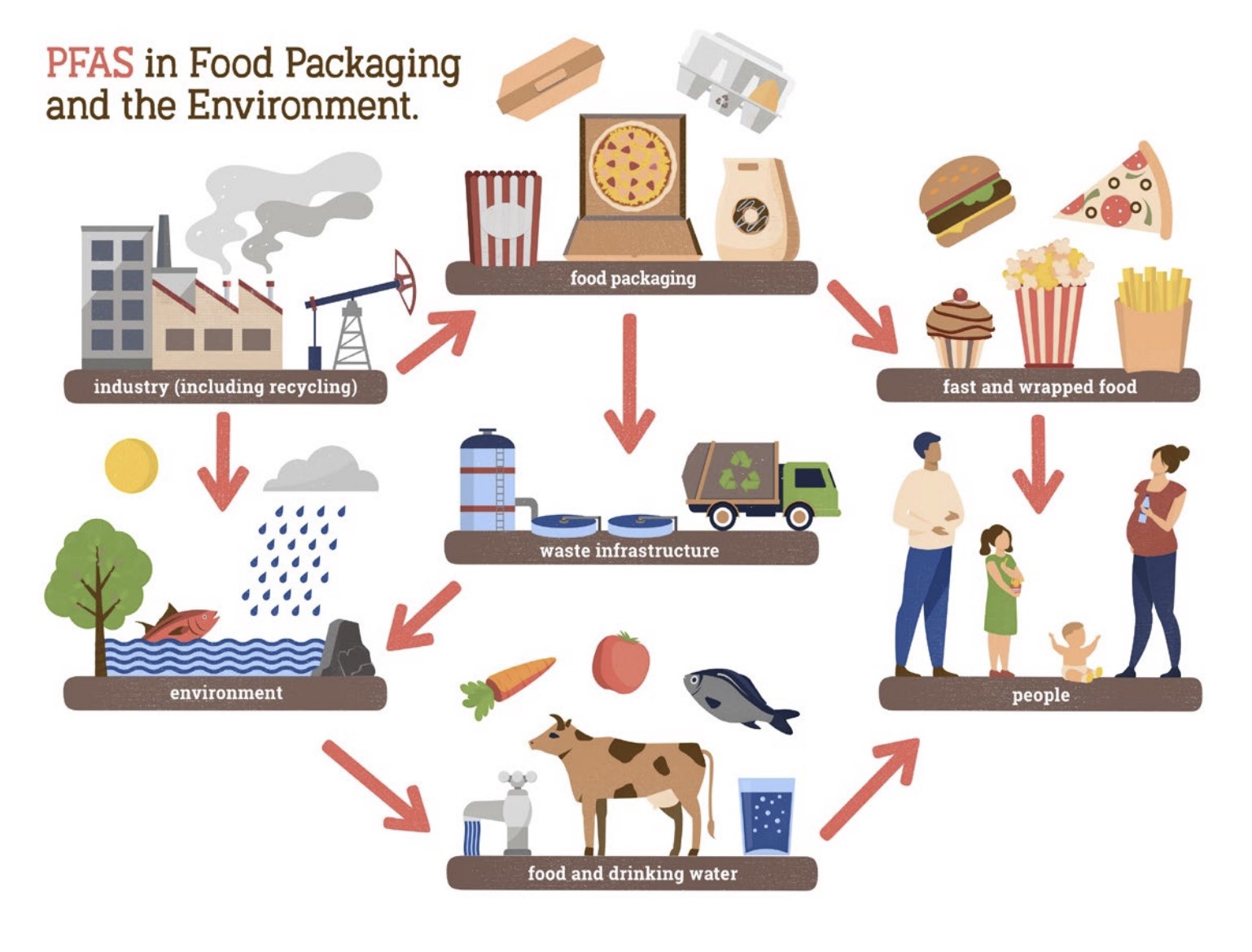
· PFAS can migrate into food under high temperature or high fat conditions.
· Excessive exposure in humans may lead to health problems such as reproductive and developmental toxicity, immunotoxicity, liver damage, endocrine disruption, and potential carcinogenicity.
· With the incineration and landfilling of food packaging waste, PFAS may pollute soil and groundwater and damage the ecological environment.
-
International and Domestic Controls: Growing Regulatory and Market Pressure
As regulations and major brands tighten their control over PFAS, packaging manufacturers face growing compliance pressure.
The EU's PPWR (Packaging and Packaging Waste Recycling Regulation) requires that from August 12, 2026, the concentration of any single PFAS measured by targeted analysis must not exceed 25 ppb, the total target PFAS must not exceed 250 ppb, and a total fluorine content of 50 ppm is used as the threshold to verify fluorine source.

Several US states have already enacted laws related to PFAS substances in food packaging prohibiting the "intentional addition" of any PFAS to food contact materials.
As a signatory to the Stockholm Convention, China adopts precise control measures based on a list of key new contaminants. The industry is also self-regulating through group standards to promote product compliance and safety further.
-
Transformation: How to Put Hazardous PFAS Replacement Technologies into Action?
To achieve transformation, companies face challenges including performance, cost, safety, and compliance.
Current non-fluorinated alternatives still fall short of PFAS levels in key performance aspects such as water resistance, oil resistance, and high-temperature resistance, and are also more expensive. The potential toxicity risks of some alternatives cannot be ignored.
What's more new raw materials and chemicals are often not permitted to use in food contact materials, and compliance issues also need attention.
Feasible technological routes fall into two categories:
· Physical barriers: such as cellulose-based alternatives like natural greaseproof paper plastic coatings, and composite materials such as aluminum layers.
· Chemical substitution: including the research and development of organosilicon polymers, acrylic polymers, and bio-based coatings. Regarding the safety assessment of these alternatives, Director Zhong recommends a multi-dimensional detection and assessment strategy of "total fluoride initial screening + targeted confirmation + non-targeted fallback" to cover substances of very high concern .
-
Enterprise Transformation: Key Issues Cannot Be Ignored
In promoting PFAS substitution technologies, Director Zhong pointed out that enterprises need to pay special attention to the following issues:
• Supply chain background pollution: Pollution from auxiliary materials, process water and the production environment may lead to excessive fluoride content in products.

• Compliance risks of alternative products: Incomplete toxicological data for new alternatives and lack of official evaluation and approval to use in food packaging pose compliance risks in countries that put into action positive list systems.
• Post-disposal environmental responsibility: Some alternatives, although labeled as "compostable," may still contain PFAS, which could cause environmental pollution and subsequent lawsuits.
• Insufficient supply chain transparency: PFAS has multiple definitions, suppliers have differing understandings of "PFAS-Free", and there are obstacles in information transmission between upstream and downstream suppliers. The completeness of material disclosure has an influence on final compliance.
6. Future Development: Stricter Controls Technological Innovation is Key
In the next 3-5 years, the transformation of PFAS in the food contact materials sector will see three main trends:
-
Upgraded Control Policies: From restricting specific substances to restricting or banning PFAS unless there are special uses.
-
Tighter Testing Standards: The adoption of total fluoride/total organic fluoride thresholds plus PFAS content limits will become a global consensus, and this requires more precise testing technologies.
-
Circular Economy Adjustment: Fluorinated waste paper may become a "risky asset," and the industry needs to focus on promoting the transformation to virgin pulp systems and the use of PFAS-free materials.
Foodtechx believes that establishing a multi-dimensional and systematic governance framework is necessary to achieve better solutions:
-
Deepening Research, Strengthening the Foundation: Continuous and in-depth scientific research on the scope and depth of the hazards of fluorides (new alternatives) is essential to avoid "unknown risks replacing known risks."
-
Technology First, Precise Control: The development of multi-dimensional and scientific testing methods such as "total fluoride screening + targeted confirmation + non-targeted fallback", is necessary to tackle the control challenges of ten thousand PFAS.
-
Balanced Legislation Emphasis on Applicability: Relevant regulations should strike a balance between "convenience" and "safety," improving operability through risk grading and phased rollout rather than a simple "one-size-fits-all" approach.
- Clear Rewards and Penalties, Guiding Transformation: Offer incentives to companies that adopt leading technologies or switch proactively (e.g., subsidies green procurement), and constrain those who fail to act using economic means to speed up industry transformation.
- Differentiated Scenarios, Educating Consumers: Put differentiated management into action based on risk assessments for different application scenarios (e.g. high-temperature high-fat versus room-temperature drying), and share accurate application knowledge with consumers to avoid misunderstandings and panic.
This framework goes beyond a simple "prohibition" mentality building a complete closed loop from basic research technological support, policy tools to market guidance and social consensus, offering a clear and practical path for the industry toward safe friendly, and sustainable high-quality development.
Source: Adsale Plastics & Rubber Network