Republished & Adapted by FoodTechX – Leading insights on food hydrocolloids, high-pressure processing (HPP), fruit puree technology, and flavor science.
Original Source: Food Hydrocolloids, Volume 179, October 2026, 112813
PII: S0268005X26003954
DOI: https://doi.org/10.1016/j.foodhyd.2026.112813
Authors: Gege Liu, Qinqin Chen, Jinfeng Bi
Introduction: Unlocking Flavor Control Through Pectin Modification in Peach Processing
High-pressure processing (HPP) is a well-established non-thermal method of microbial inactivation for many applications in the fruit juice and puree sector in which fresh-like qualities of the product are maintained. But its role in the interplay between pectin structure and aroma compounds has been little studied – until now.
The new study, published in Food Hydrocolloids (2026), offers novel insights into the reorganization of pectin in NFC peach puree caused by HPP (450–600 MPa) and its direct impact on the release and retention of characteristic peach aromas. The findings of this study will provide the food technologist with practical information to help them formulate new and improved premium fruit products with optimum flavor, texture, and shelf-life.
Key Highlights from the Study
- HPP significantly alters peach pectin structure, with the most notable changes at 450 MPa producing RG-I-enriched pectin.
- Different pressure levels shift the balance between homogalacturonan (HG) and rhamnogalacturonan-I (RG-I) domains, molecular weight (Mw), and degree of esterification (DE).
- Eight aroma-active compounds were identified, with strong correlations between pectin structural parameters and key volatiles.
- Specific RG-I region modifications influence fresh/green and fruity aroma notes.
- Optimized HPP conditions can enhance desirable aromas like benzaldehyde while modulating esters and aldehydes.
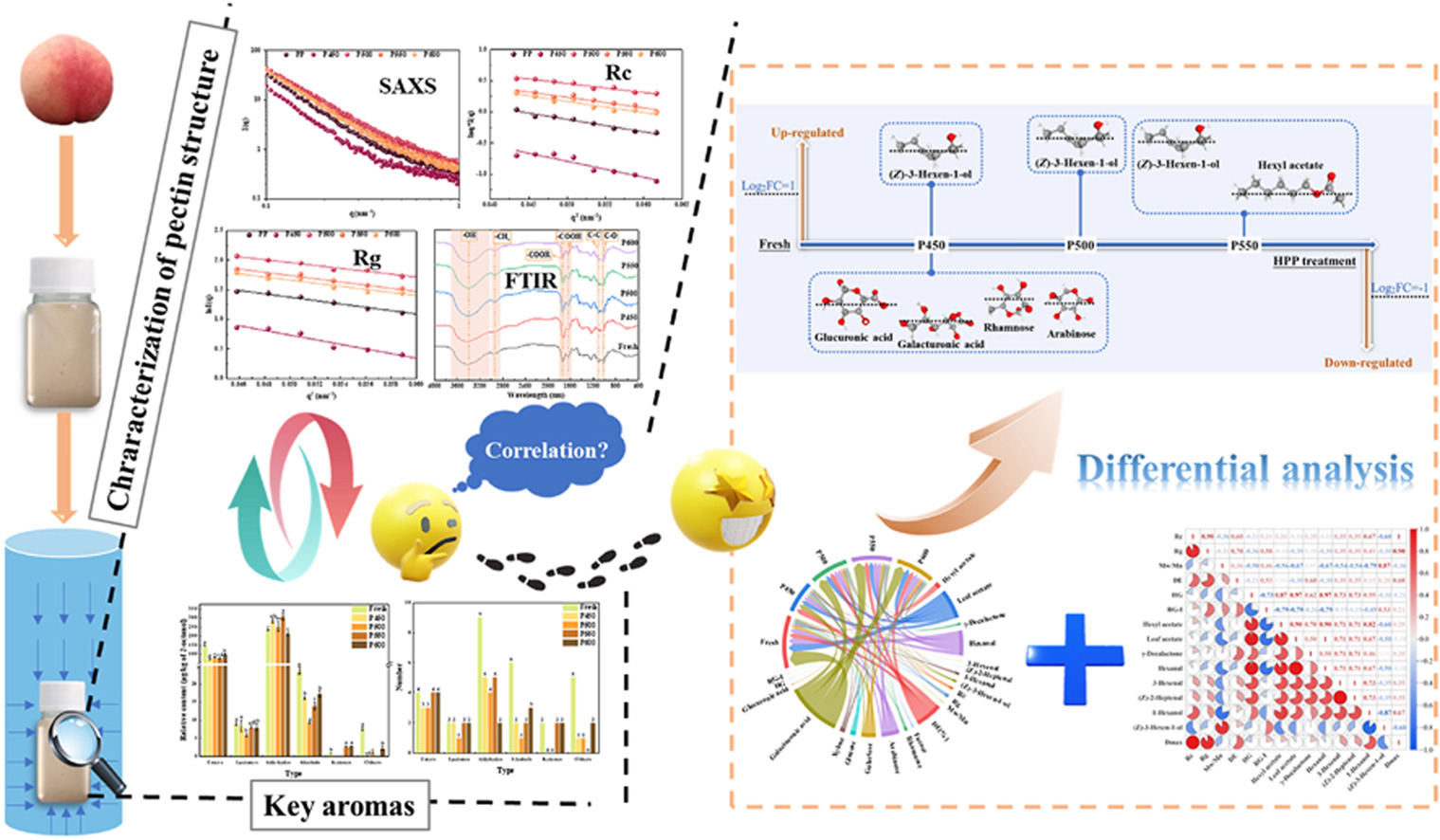
Pectin Structural Changes Under HPP
- Reduced weight-average molecular weight (Mw) overall.
- Highest degree of esterification (DE) at 450 MPa (78.78%), with the lowest Mw (525 kDa), resulting in RG-I-enriched pectin.
- At 500–600 MPa: HG-enriched pectin with increased Mw (543–577 kDa), lower DE (64.28–64.78%), and more compact conformations.
Impact on Aroma Profile in NFC Peach Puree
- Benzaldehyde (almond-like, cherry-like note) increased dramatically — by 1.49 to 2.98 times.
- Changes in ester and aldehyde levels contributed to shifts in fruity and green aroma intensities.
- Key aroma compounds such as (Z)-3-hexen-1-ol (fresh/green) and hexyl acetate (fruity) were strongly correlated with pectin parameters including HG/RG-I ratio, Mw distribution, polydispersity (Mw/Mn), and maximum dimension (Dmax).
Practical Implications for Food Processing and Product Development
This study provides practical recommendations for the food industry:
• Flavor Optimization: HPP processors can adjust the parameters to accentuate certain aroma attributes (such as more benzaldehyde or to balance the green/fruity character) in peach purees, juices, and beverages.
• Clean-Label Products: Better understanding of natural pectin-aroma interactions supports minimal-additive formulations with superior sensory quality.
• Texture and Stability: Pressure-induced pectin changes also influence viscosity, mouthfeel, and physical stability of NFC products.
• Premium NFC purees: Knowledge of these can help manufacturers to keep the fresh-like flavor of their purees for longer, giving them a competitive edge in the market.
• Other use: Results are applicable to other fruit purees, juices and other HPP processed products where polysaccharide-aroma interaction is significant.
How is this study relevant to FoodTech Professionals?
Consumer demand for natural, quality, less processed fruit products will be increased to gain structural modifications control over flavor is a powerful competitive advantage. This study brings together the basic science of pectin and food engineering principles, aiming to make HPP more than a mere preservation technology, transforming it into a precision tool for flavor control in food products.
It also contributes to the expanding knowledge base on structure-function relation in food hydrocolloids that enable new functional beverages, baby foods, dairy alternatives, and bakery fillings that utilize peach or other fruit ingredients.
Full Citation: Liu, G., Chen, Q., & Bi, J. (2026). Pressure-driven pectin reorganization: Relationship between the structural properties and the characteristic aroma compounds behaviour in NFC peach puree. Food Hydrocolloids, 179, 112813.