Published: February 10, 2026 (Original source: Chinese Academy of Agricultural Sciences)
Republished and translated by FoodTechX – We advance food technology and safety innovations worldwide
In a significant advancement for pesticide residue monitoring and food safety, researchers from the Chinese Academy of Agricultural Sciences (CAAS) have developed a novel enzyme inhibition method using a peptide-copper (peptide-Cu) nanozyme to detect thiram — a used dithiocarbamate fungicide. Published in the prestigious journal Food Chemistry, this breakthrough expands enzyme-based detection beyond high-toxicity organophosphorus pesticides to include common fungicides like thiram and offers a simple, cost-effective and field-deployable solution.
Thiram (tetramethylthiuram disulfide) applied to fruits, vegetables and seeds to control fungal diseases, can leave residues that pose potential health risks if they exceed regulatory limits. Traditional detection methods often need expensive laboratory equipment skilled technicians, and time-consuming sample preparation. The new approach solves these problems by using a synthetic nanozyme with peroxidase-like activity.
How the Peptide-Copper Nanozyme Works to Detect Thiram
The research team led by the Agricultural Product Quality and Safety Detection Technology Innovation Team at the Institute of Quality Standards and Testing Technology for Agro-Products (IQSTAP) CAAS, built a peptide-Cu nanozyme that mimics natural peroxidase enzymes. This nanozyme catalyzes the oxidation of substrates (such as TMB in the presence of H₂O₂) and produces a visible colorimetric change.
Thiram acts as an inhibitor binding to the nanozyme and reducing its catalytic activity. This inhibition is concentration-dependent, enabling quantitative detection through simple colorimetric readout — either by eye or using a portable spectrophotometer.
To develop a deeper understanding, the researchers employed computational simulations:
-
Molecular dynamics (MD) simulations revealed how thiram disrupts the structural stability of the peptide-Cu complex.
-
Density functional theory (DFT) calculations clarified the synergistic inhibition mechanism showing changes in electronic properties that impair catalytic performance.
This combination of experimental and theoretical insights provides a solid foundation to support the method's reliability.
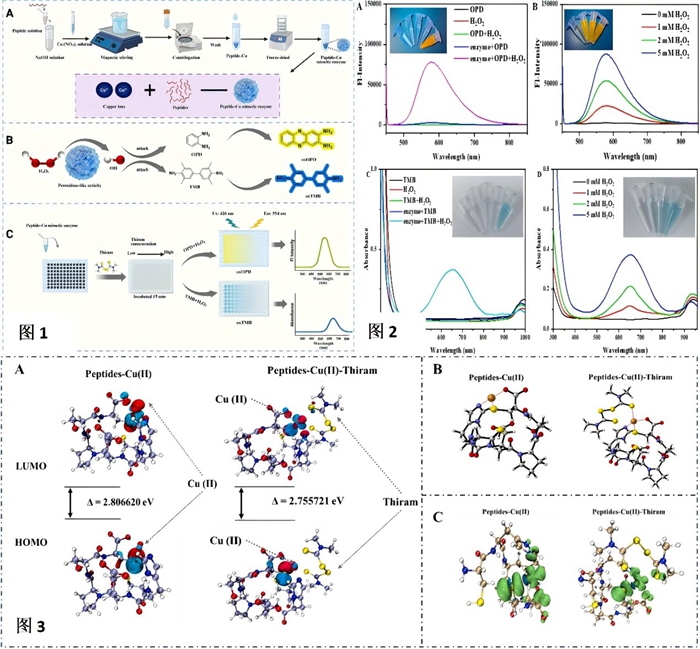
Performance and Validation Results
After optimization, the detection method demonstrates excellent analytical performance:
-
Linear range: 0.01–5 μg/mL (micrograms per milliliter)
-
Limit of detection (LOD): 0.048 μg/mL--sensitive enough to meet many international maximum residue limits (MRLs) for thiram in food
-
Recovery rates: Strong performance in real-world spiked samples, including cucumber, carrot, pear (common vegetables and fruits), and tap water
-
Anti-interference: High selectivity with minimal matrix effects from complex food samples
These metrics make the method suitable for on-site rapid screening and reduce reliance on centralized labs and chromatographic techniques like HPLC-MS.
Significance for Food Safety and Pesticide Monitoring
This breakthrough represents a re-invention of enzyme inhibition-based pesticide residue detection.limited to organophosphorus and carbamate insecticides that target acetylcholinesterase, the approach now extends to dithiocarbamate fungicides like thiram.
Key benefits include:
-
Simplicity and economy: No need for sophisticated instruments; potential for portable test kits
-
Speed: Results in minutes rather than hours or days
-
Field applicability: Ideal for farmers, food processors, regulators, and quality control labs
-
Broader impact: Enhances consumer confidence in produce safety and supports stricter enforcement of pesticide regulations
The research received support from major funding programs, including the CAAS Science and Technology Innovation Project, the National Key Research and Development Program of China, and the National Natural Science Foundation of China.
Looking Ahead: Implications for FoodTech and Agro-Chemical Testing
As global demand grows for faster, greener and more accessible food safety testing, nanozyme-based sensors like this peptide-Cu system could pave the way for next-generation detection platforms. Integration of such technologies with smartphones or IoT devices could enable real-time monitoring across supply chains — from farm to fork.
This breakthrough from China's leading agricultural research institution highlights the power of interdisciplinary collaboration (with partners from Shanxi University, Cairo University and others) in solving practical food safety challenges.
Original publication: Food Chemistry DOI: 10.1016/j.foodchem.2026.147882
Source: Chinese Academy of Agricultural Sciences (CAAS), Institute of Quality Standards and Testing Technology for Agro-Products
Republished with adaptations for international readers by FoodTechX.com
Keywords: thiram detection, nanozyme pesticide sensor, peptide-copper nanozyme, food safety testing, pesticide residue analysis, enzyme inhibition method, rapid fungicide detection