Published: April 2026
Republished & Adapted by FoodTechX – Insights on AI, deep learning, and smart technologies transforming food production, vertical farming, and controlled-environment agriculture.
Original Source: Computers and Electronics in Agriculture (2026)
Authors: Yubin Zhang, Yanqi Zhang, Qixin Sun, Zhaoxin Li, Xiao Liu, Xiujuan Chai, Tan Sun
Introduction: Solving a Major Challenge in Precision Agriculture and Vertical Farming
Accurately predicting the fresh weight of leafy greens like lettuce throughout their entire growth cycle has long been a difficult task in controlled-environment agriculture (CEA). Traditional computer vision models often struggle, especially during the early seedling stage when plants have limited visible morphological features.
A groundbreaking 2026 study titled “Integrating plant physiology with deep learning for fresh weight prediction across lettuce growth cycles” offers a powerful solution. By fusing biological knowledge with advanced deep learning techniques, researchers have developed a unified framework that delivers highly accurate, stage-aware fresh weight predictions using non-destructive RGB-D imaging.
This innovation holds significant value for foodtech professionals, vertical farm operators, automated plant factory managers, and ag-tech companies aiming to optimize yield, reduce waste, and enhance resource efficiency in smart food production systems.
Research Background and Key Challenges
Lettuce and other leafy vegetables exhibit substantial phenotypic variation across growth stages. Early seedlings provide very few visual cues, making biomass estimation unreliable with purely data-driven deep learning models. Most existing methods are optimized for mature plants and perform poorly on young crops, limiting their usefulness in real-world high-throughput phenotyping platforms.
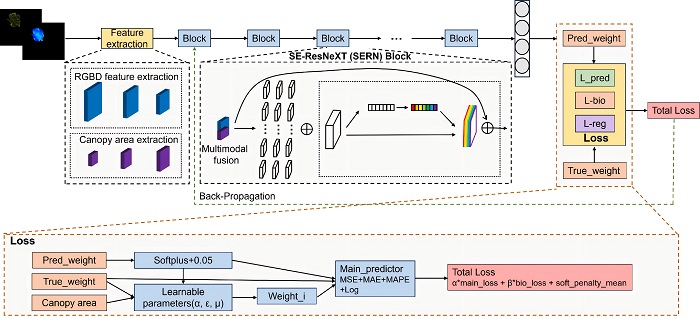
To overcome these limitations, the research team proposed a hybrid knowledge-data-driven framework that embeds plant physiological principles — specifically allometric scaling laws between canopy area and biomass — directly into the deep learning optimization process.
Core Innovation: Physiology-Informed Deep Learning Framework
The study introduces several novel components:
- Physiology-Constrained Loss Function: A biologically inspired loss function based on the power-law (allometric) relationship between canopy metrics and fresh weight. This guides the neural network with real plant growth science rather than relying solely on statistical patterns.
- Three Adaptive Strategies for stage-aware learning:
- Regional weight indexing
- Error sensitivity adjustment
- Micro-sample weight amplification
These mechanisms allow the model to pay special attention to difficult early-stage samples while maintaining high accuracy during later growth phases.
- Multi-Modal Input: The model uses RGB-D canopy images captured by an Intel RealSense D405 depth camera mounted on a high-throughput phenotyping platform. Combining color (RGB) and depth information provides richer 3D structural data than traditional 2D images.
- Multibranch Convolutional Neural Network (CNN) architecture that processes RGB, depth maps, and derived canopy features.
Methodology Highlights
Researchers grew lettuce under controlled conditions and collected paired RGB-D images and destructive fresh weight measurements across the complete growth cycle. Each image captured 1–4 plants to reflect realistic planting density.
The team evaluated different deep learning backbones and conducted ablation studies to verify the contribution of each component (physiological loss, adaptive strategies, and multi-modal inputs). Canopy detection models were also tested to ensure accurate region-of-interest extraction.
Impressive Results and Performance Metrics
The proposed framework delivered outstanding results:
- Acceptable Prediction Rate: 92.96% of predictions fell within a ±10% error range across the full growth cycle.
- Mean Absolute Percentage Error (MAPE): 4.48% — significantly better than state-of-the-art methods.
- Strong performance improvements, particularly in the early seedling stage, where conventional models typically underperform.
- Robust results when tested across different canopy area quartiles, proving the model’s ability to handle both challenging young plants and mature ones effectively.

Why This Matters for FoodTech and Smart Agriculture
This research has direct applications in several high-growth foodtech areas:
- Automated Plant Factories & Vertical Farming: Real-time fresh weight prediction enables precise yield forecasting, dynamic environmental control (light, nutrients, CO₂), and optimized harvest scheduling.
- Resource Efficiency: Accurate monitoring helps reduce energy consumption, water usage, and nutrient waste — critical for sustainable indoor agriculture.
- High-Throughput Phenotyping: Supports large-scale breeding programs and quality control by providing scalable, non-destructive data.
- AI-Driven Decision Making: The framework can integrate into edge-cloud hybrid systems for continuous crop monitoring and predictive analytics.
- Broader Leafy Greens Applications: While tested on lettuce, the approach is transferable to other vegetables like spinach, kale, and herbs commonly grown in CEA systems.
Conclusion: A New Standard for AI in Crop Monitoring
By successfully bridging plant physiology and deep learning, this 2026 study sets a new benchmark for fresh weight prediction in controlled-environment agriculture. The framework not only achieves high overall accuracy (92.96% within ±10% error) but also resolves long-standing weaknesses in early growth stage prediction.
For foodtech companies, vertical farm operators, and ag-tech developers, this approach offers a practical, scalable tool to enhance automation, improve yield consistency, and drive the digital transformation of future food production systems.
Original Article Link: ScienceDirect
Full Citation: Zhang, Y., et al. (2026). Integrating plant physiology with deep learning for fresh weight prediction across lettuce growth cycles. Computers and Electronics in Agriculture.
Full Citation: Zhang, Y., et al. (2026). Integrating plant physiology with deep learning for fresh weight prediction across lettuce growth cycles. Computers and Electronics in Agriculture.
Keywords: lettuce fresh weight prediction, deep learning plant physiology, RGB-D imaging agriculture, precision agriculture AI, vertical farming monitoring, automated plant factory, crop phenotyping 2026, allometric scaling deep learning, smart agriculture lettuce, controlled environment agriculture AI