2026
2026


Product Overview
The NKT2020-H high-performance, fully automatic dry-method laser particle size analyser integrates internationally advanced optical technology with intelligent automation, setting a new benchmark for precise particle size analysis. Designed specifically for laboratories in large enterprises, universities and research institutes, it meets the high-precision testing requirements of powder application research, new material development, and powder quality and production process control. The instrument strictly adheres to Mie scattering theory and employs a proprietary forward-reverse Fourier composite optical path design. This incorporates a three-lens optical system comprising a Fourier collimating lens, a filter lens and a standard Fourier transform lens, ensuring the precision and stability of the optical path from the light source to the signal receiver, thereby laying the foundation for high-precision measurement. Equipped with a high-density photodetector array probe and full-range seamless testing technology, the instrument achieves comprehensive coverage of the detection range and ensures no signal is missed, guaranteeing exceptional accuracy and excellent repeatability of test results. The unique dry dispersion system employs a residue-free pipework design, effectively preventing particle deposition and residue. This not only guarantees accuracy between tests of different samples but also completely eliminates cross-contamination, ensuring that the second and subsequent tests maintain high precision. The testing process operates intelligently and fully automatically, requiring no manual intervention. The entire measurement process can be completed with a single button press, significantly enhancing operational efficiency whilst making test results more stable and reliable, thereby meeting the demands of high-end scientific research and stringent industrial quality control.

Scope of Application
-
Industrial Minerals and Powders: Non-metallic powders such as heavy calcium carbonate, talc and kaolin; metallic powders such as aluminium, copper and rare earths; building materials such as cement, ceramic powders and graphite powder;
-
Energy and Chemical Materials: Lithium-ion battery cathode and anode materials, catalysts, phosphors, rubber and plastic additives (in powder form), powder coatings, etc.;
Pharmaceuticals and Biologics: Active pharmaceutical ingredient powders, micro-pellets, ultrafine powders of traditional Chinese medicine, spray-dried formulations, etc.; -
Food and personal care: starch, protein powders, powdered pigments, dye powders, powdered cosmetic ingredients, etc.;
-
Environment and geology: dust, aerosols, soil particles, dried sediment samples, etc.;
-
Other typical dry-processing applications: metal micropowders, 3D printing powders, laser cladding powders, propellant powders, magnetic material powders, and other particulate samples that are prone to degradation upon contact with liquids or require maintenance of a dry state.
Technical Explanation
End-to-end, one-click intelligent testing – minimised operation, consistent results
With built-in, editable SOPs (Standard Operating Procedures), a single click initiates the entire testing process—from water intake, degassing and background measurement, through sample dispersion and data acquisition, to data saving and instrument cleaning. By leaving complex operations to the instrument, the operator need only load the sample, significantly reducing reliance on operator experience. This mode completely eliminates the inevitable procedural variations and subjective errors associated with manual operation, ensuring that test data remains highly consistent and reliable regardless of the operator or the time of testing. It perfectly aligns with GLP laboratory standards and quality traceability system requirements.
1 LIMS Laser Intelligent Management System — Intelligent Optics, Sustained Stability
Integrated with the advanced LIMS Laser Intelligent Management System, it enables precise and intelligent control of the laser light source. The system monitors the optical path status in real time, instantly activates the laser upon receiving a test command, and rapidly reaches a stable operating state within 3 seconds, significantly reducing waiting times and enhancing testing efficiency. Upon completion of the measurement, the system automatically shuts down the laser, fundamentally eliminating energy wastage from idle standby. This intelligent management technology effectively prevents light attenuation caused by prolonged laser operation, significantly extending the service life of core components. Theoretically, the laser is designed to require no replacement throughout its lifetime, delivering ultimate reliability and ultra-low maintenance costs to customers.
1 Ultra-High-Speed Signal Acquisition System — Transient Capture, Insight into the Minute
Equipped with a fifth-generation ultra-high-speed signal acquisition motherboard, the system achieves an ultra-high sampling frequency of 10,000 times per second. Thanks to this hardware-level breakthrough, the system can comprehensively and synchronously capture all particle scattered light signals without omission within the 0.1-second instant that a sample passes through the measurement zone. This completely resolves the issue of signal loss caused by the random orientation of particles, thereby ensuring the utmost precision and high repeatability of particle size distribution results.
1 Forward-Reverse Fourier Composite Optical System — Three-Lens Synergy, Consistent Precision
Employing a proprietary forward-reverse Fourier composite optical path, this system integrates a Fourier collimating lens, a filtering lens and a standard Fourier transform lens to form a high-performance three-lens optical system. It ensures precise and stable optical alignment throughout the process, providing a solid foundation for high-precision measurement of core particle size parameters.
1 Sixth-Generation Long-Life, High-Stability Photodetector — Meticulously Engineered for Consistent Precision
The core photodetector array is equipped with Nektar’s proprietary sixth-generation high-stability photodetector. Manufactured using specially selected, high-performance raw materials imported from Germany, it possesses exceptional resistance to oxidation and ageing, ensuring virtually no degradation in photoconversion efficiency over a ten-year period. The theoretical lifespan of the detectors matches that of the entire instrument, eliminating the need for replacement throughout its lifetime. This fundamentally ensures the long-term consistency and accuracy of measurement data, whilst delivering exceptionally low lifetime maintenance costs.
1 Intelligent Dual-Alignment Optical Path System — One-Button Calibration, Dynamic Stabilisation
A pioneering dual optical alignment system that integrates both mechanical and optical alignment technologies. It enables one-touch activation and instantaneous, precise alignment, eliminating the need for cumbersome manual adjustments. Furthermore, the system continuously monitors and automatically maintains the optimal optical path throughout the entire usage cycle, ensuring long-term stability of measurement results and high instrument reliability, offering true peace of mind and convenience.
1 Intelligent Optical Dynamic Compensation Algorithm – Overcoming Concentration Limits Through Algorithmic Intelligence
Equipped with Nektar’s pioneering Intelligent Optical Dynamic Compensation Algorithm. This algorithm simultaneously provides dual real-time compensation for both optical aberrations caused by the Airy disk and variations in sample concentration, overcoming the measurement limitations of traditional instruments. Even within the ultra-wide opacity range of 3% to 90%, accurate and reliable particle size distribution data can be obtained directly, without the need for repeated adjustments to sample concentration, thereby significantly enhancing testing efficiency and data comparability.
1 Misoperation Protection System — Intelligent Safeguards, Fearless Against Errors
Features a comprehensive, built-in intelligent error-proofing protection system that integrates hardware interlocks with intelligent software decision-making. The system detects non-compliant operations in real time, immediately triggering active alerts and interrupting the process; it does not respond to invalid commands, thereby fundamentally eliminating hardware damage caused by human error. This significantly enhances the equipment’s durability and operational safety, giving you complete peace of mind.
1 Multi-impact Dry Dispersion Technology — Efficient Disaggregation, Powerful Dispersion
Utilising multi-impact dry dispersion technology, high-speed airflow guides the powder through multiple stages of physical collision, achieving efficient deagglomeration of ultra-fine and easily agglomerating powders. This ensures that particles pass through the detection zone in a single-particle state, significantly enhancing the accuracy and repeatability of ultra-fine dry powder measurements.
1 Professional-grade dustproof and anti-vibration design — Unaffected by environmental fluctuations, ensuring consistent data
Featuring a professional, integrated sealed dust-proof system and anti-vibration design, it effectively prevents the ingress of external dust and the transmission of vibrations. This design ensures the long-term stability and precise focusing of the core optical system; the detector position requires no manual adjustment, significantly reducing maintenance frequency and guaranteeing exceptional repeatability and reliability of measurement results, even in complex industrial environments.
1 Residue-Free Direct Injection System — Precision Direct Injection, Not a Trace Left
Utilising precision stainless steel piping and direct-injection dry sampling technology, the optimised gas pathway design and pipe wall construction ensure zero sample residue remains in the piping after testing. This completely eliminates the risk of cross-contamination, greatly safeguarding the accuracy and repeatability of continuous measurements, making it particularly suitable for particle size-sensitive and high-frequency testing scenarios.
1 High-Speed Turbulent Dry Dispersion System — Ultra-High Vacuum, Anti-Agglomeration
Equipped with a dry dispersion system optimised based on French turbulent dispersion pump theory, it utilises the Venturi effect to generate ultra-high vacuum, ensuring continuous, uniform sample feeding and high-level dispersion. This completely resolves the issue of powder particle agglomeration, guaranteeing precise and reliable test results.
1 Intelligent Multi-dimensional Reporting and Analysis System — Flexible, Efficient, Intelligent and Intuitive
Equipped with professional-grade particle size analysis software, it integrates a robust database and a multi-dimensional reporting system. It supports multi-format report export and customised editing, and features a function for comparing multiple sets of data on a single screen, significantly enhancing data interpretation efficiency and report generation flexibility, fully meeting the requirements of research, quality control and compliance.
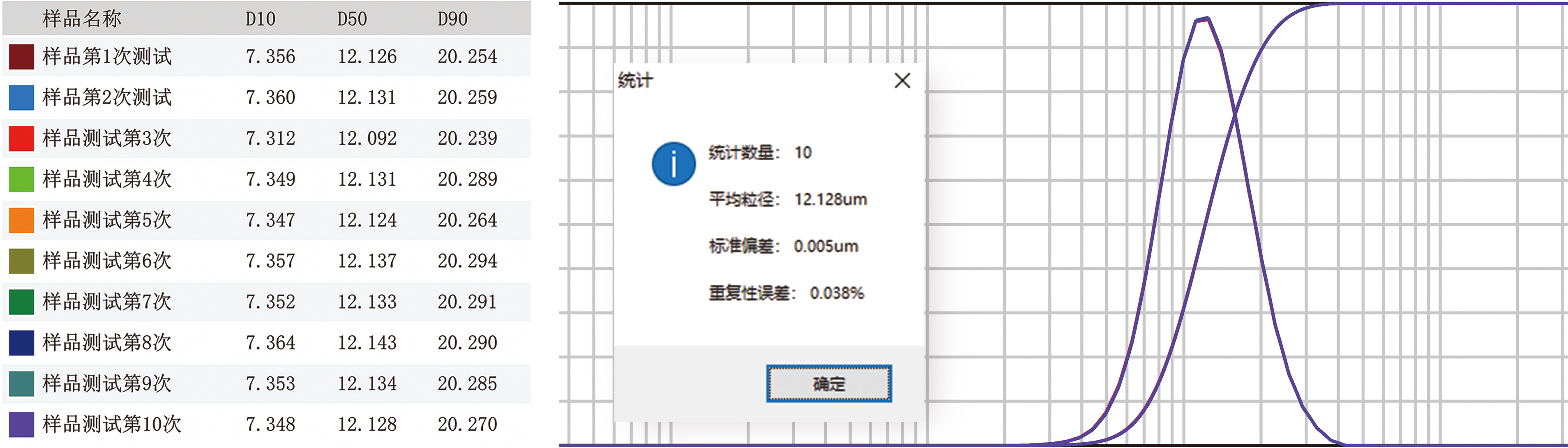
1 High Repeatability
The NKT2020-H offers excellent repeatability, with measurement results remaining highly consistent across multiple experiments, typically maintaining an error margin within a very narrow range. This outstanding repeatability stems from the instrument’s precision optical system design and stable laser light source, ensuring that the conditions for capturing particle-scattered light signals are identical in every test. Whether testing consecutive batches of samples or measuring the same sample at different time points, the laser particle size analyser provides stable and reliable particle size distribution data. This effectively mitigates the impact of human operational variations and environmental fluctuations on results, providing robust data support for quality control in both scientific research and industrial production.
1 High accuracy and resolution
The NKT2020-H offers excellent accuracy and resolution. Through its precise optical system and advanced data processing algorithms, it is capable of performing high-precision particle size distribution measurements on particulate samples. In terms of accuracy, the instrument utilises a stable laser light source to ensure uniform and consistent beam intensity. Combined with a precision detector array, this keeps measurement errors within an extremely narrow range—typically within ±0.5%—accurately reflecting the sample’s true particle size characteristics. Regarding resolution, the laser particle size analyser can clearly distinguish between particle groups of different sizes, effectively identifying even subtle differences in particle size.